
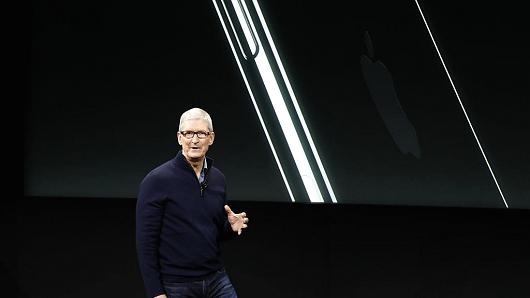
Stephen Lam | Getty Images
Apple CEO Tim Cook speaks during a product launch event on Oct. 27, 2016, in Cupertino, Calif.
But the task won’t be easy, something that Apple has admitted. The company’s vice president of environment, policy and social initiatives told VICE news that Apple doesn’t know how it will be achieved.
“We’re actually doing something we rarely do, which is announce a goal before we’ve completely figured out how to do it,” Lisa Jackson said.
Apple described some of the initiatives it has in place to hit its goal. It has a robot called Liam which is able to disassemble products and recover components that can be recycled. The company is also encouraging customers to return products through its Apple Renew recycling program.
The world’s second-largest smartphone maker is also looking into ways to reuse materials. For example, it melted down the aluminum enclosures on the iPhone 6 to make Mac mini computers to use in its factories and it said that it is moving to 100 percent recycled tin solder on the main logic board of iPhone 6s.
It has focused on a different way of producing aluminum which has resulted in the iPhone 7 enclosure using 27 percent less of the material than the iPhone 6, and emitting 60 percent less greenhouse gas emissions.
Of course, Apple also relies heavily on many suppliers to provide components for its devices and this can often be where there are issues with so-called “conflict minerals” and environmentally-disastrous production techniques. But Apple said that seven major suppliers have now pledged to power their Apple production entirely with renewable energy by the end of next year.
“And we’re making strides toward our commitment to bring 4 gigawatts of renewable power online by 2020, a key step in reducing our manufacturing footprint,” the company’s report said.