

A court on Monday fined Russian opposition leader Alexei Navalny 20,000 rubles (about $470 Cdn) for his role in organizing what the authorities said was an illegal protest in Moscow on Sunday.
It’s a comparatively lenient punishment — he was facing up to 15 days in jail.
The same court was due, later on Monday, to consider a separate charge against him of disobeying a police officer.
Navalny was detained Sunday after leading a major opposition rally against government corruption.
Tens of thousands of protesters took to the streets across Russia on Sunday in the biggest show of defiance since 2011-2012 anti-government protests.
The Kremlin has lashed out at protest organizers, blaming them for putting lives at risk by inviting people to unsanctioned demonstrations.
The government dismissed the opposition as Westernized urban elite disconnected from the issues faced by the poor in Russia’s far-flung regions, but Sunday’s protests included demonstrations in the areas which typically produce a high vote for President Vladimir Putin, from Siberia’s Chita to Dagestan’s Makhachkala.
Russian police say that about 500 people were arrested, while human rights groups say 1,000 were taken into custody. On Monday, the European Union called on Russian authorities to release the demonstrators.
Navalny most popular opposition leader
The protests were led by Navalny, a charismatic opposition leader who recently announced his bid for presidency. Navalny was grabbed by police while walking to the rally from a nearby subway station.
He posted a selfie on Twitter from the courtroom on Monday morning, saying: “A time will come when we’ll put them on trial too — and that time it will be fair.”
The 40-year-old Navalny, arguably Russia’s most popular opposition leader, has been twice convicted on fraud and embezzlement charges that he has dismissed as politically motivated. Navalny is currently serving a suspended sentence.
Separately, police arrested Navalny’s associates who were at their office setting up and monitoring a webcast of the rally. Thirteen of them spent the night at a police station while authorities raided their office, reportedly removing all equipment. It wasn’t immediately clear what charges they may be facing.
Over the years, Navalny, a trained lawyer, evolved from a lone blogger to someone who leads a group of like-minded activists, the Anti-Corruption Foundation, whose full-time job is to investigate official corruption.
State TV ignored protests
Russian state television completely ignored the protests in their broadcasts on Sunday, and authorities didn’t comment on it in any way.
Putin’s spokesman chided protest organizers, saying they incited illegal acts.
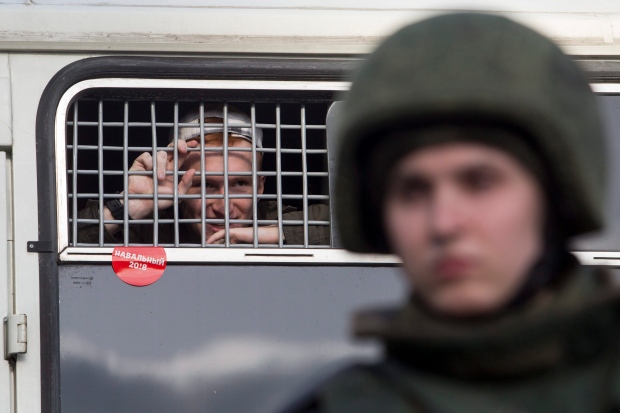
Along with Navalny, at least 500 other people were arrested. (Denis Tyrin/Associated Press)
“The Kremlin respects people’s civic stance and their right to voice their position,” Dmitry Peskov told reporters. “We can’t express the same respect to those who consciously misled people and who consciously did it yesterday and provoked illegal actions.”
Peskov defended police who were seen manhandling protesters, some of whom were underage, calling their response “highly professional and lawful.”
Asked about the Kremlin’s reaction to the wide geography of the protests, something that has not been seen at least since 2011, Peskov said, “The Kremlin is quite sober about the scale of yesterday’s protests, and are not inclined to diminish them or push them out of proportion.”
Putin “constantly talks to people” and is well-briefed on the sentiment in the country, Peskov insisted.
He also claimed that underage protesters in Moscow were promised cash if they were arrested. Pressed on the source of these claims, Peskov quoted “facts.”






