

Militants are increasingly turning to vehicle ramming attacks, like the one staged near Britain’s Parliament on Wednesday, because they are cheap, easy to organize and hard to prevent, experts say.
The tactic of mowing people down with a vehicle avoids the need to obtain explosives or weapons and can be carried out by a “lone wolf” attacker without a network of fellow militants — all lessening the risk of alerting security agencies beforehand.
“This kind of attack doesn’t need special preparation, it is very low cost, within anybody’s reach,” said Sebastien Pietrasanta, a French Socialist lawmaker and terrorism expert.
“It is often a case of individual action,” he told Reuters. “They can be quite spontaneous.”
Five people were killed and at least 40 injured in London on Wednesday after a car plowed into pedestrians and an attacker stabbed a policeman close to Parliament in what police called a “marauding terrorist attack.” The attacker was shot dead.
Here’s a look at some other recent attacks where vehicles were used.
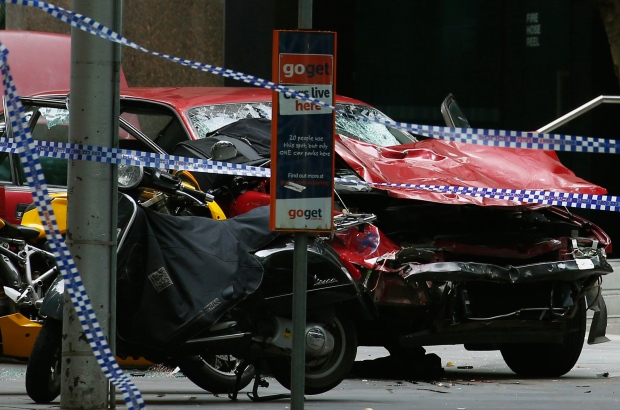
A car rammed intentionally rammed into a pedestrian mall in Melbourne, Australia, in January, killing four people and injuring 20 others. (Edgar Su/Reuters)
Jan. 20, 2017: A man with a history of mental health and drug abuse issues drove into a street crowded with pedestrians in Melbourne, Australia’s second-largest city, killing four people, including a child, and injuring around 15 others. The 26-year-old man was arrested, and police said the incident had no links to terrorism.

This frame grab from video, shows Israeli emergency services personnel covering bodies with plastic sheets at scene of a truck-ramming attack in East Jerusalem that killed four on Jan. 8. (The Associated Press)
Jan. 8, 2017: Four soldiers aged 20 to 22, three female and one male, were killed and several other injured after the driver of a semi-trailer truck targeted Israel Defence Forces at an esplanade in East Jerusalem. The Palestinian driver, identified as 28-year-old Fadi al-Qunbar was shot dead.

A truck crashed through a Christmas Market in Berlin in December leaving 12 people dead.
Dec. 19, 2016: A young Tunisian rammed a truck into a crowded Berlin Christmas market, killing 12 and injuring dozens in an attack claimed by the Islamic State group. It was the first mass casualty attack by Islamic extremists carried out on German soil. Attacker Anis Amri, who had been denied asylum in Germany, was killed by police in Italy after an international manhunt.

A truck drove through crowds in Nice, France in July. The attack killed 86 people.
July 14, 2016: A Tunisian residing in France plowed a refrigerator truck through a crowd celebrating Bastille Day on the Mediterranean beachfront in Nice, killing 86. Attacker Mohamed Lahouaiej Bouhlel was killed by police. Cities around the world beefed up measures to prevent vehicle attacks in response. ISIS claimed responsibility for the attack, but to date, a recent GQ investigation noted, no pledge of allegiance from Bouhlel to the group has been discovered.
Dec. 21, 2014: A motorist injured 13 pedestrians in the French city of Dijon; a day later, a man ran over pedestrians at a Christmas market in Nantes in western France, killing one and injuring nine. Both suspects, who survived, had histories of mental illness.

Canadian soldier Patrice Vincent, 53, was killed in October 2014 when he was purposely run over outside Montreal. (Department of National Defence)
Oct. 20, 2014: A 25-year-old man drove his car into Canadian Air Force members near Montreal, killing one of them and injuring another. Authorities said the driver was a convert to Islam and had been flagged for jihadist ambitions. He was later shot dead by police.
June 30, 2007: Two men attempted to crash a blazing Jeep loaded with explosives into Glasgow Airport in Scotland. The car’s path was blocked and the explosives failed to detonate.