

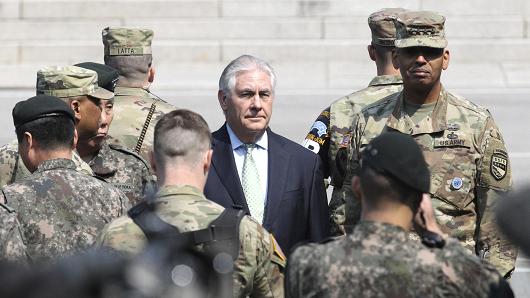
Lee Jin-man | Reuters
U.S. Secretary of State Rex Tillerson (C) visits with U.S. Gen. Vincent K. Brooks, commander of the United Nations Command, Combined Forces Command and United States Forces Korea (R) at the border village of Panmunjom, which has separated the two Koreas since the Korean War, South Korea March 17, 2017.
For now, U.S. officials consider pre-emptive strikes too risky, given the danger of igniting a regional war and causing massive casualties in Japan and South Korea and among tens of thousands of U.S. troops based in both allied countries.
Another U.S. government source said Trump could also opt to escalate cyber attacks and other covert action aimed at undermining North Korea’s leadership.
“These options are not done as stand-alones,” the first U.S. official said. “It’s going to be some form of ‘all of the above,’ probably excluding military action.”
Trump is known to have little patience for foreign policy details, but officials say he seems to have heeded a warning from his predecessor, Barack Obama, that North Korea would be the most urgent international issue he would face.
In his North Korea briefings, Trump has asked repeatedly how many nuclear warheads and missiles Pyongyang has, at the same time as demanding to know how much South Korea and Japan are paying for their own defense, one U.S. official said.





