

There’s the saber-rattling by nuclear-armed North Korea, a Chinese ally that the Trump administration believes should be brought to heel.
During the South Korea leg of his Asia tour, Tillerson touched nerves in Beijing by saying that “all options are on the table” regarding North Korea’s weapons program.
Then, Trump sent a tweet that scolded North Korea for “behaving very badly” and slamming China for “doing little to help.”
Tensions worsened on Saturday, when North Korean dictator Kim Jong Un announced the ground test of a “high-thrust” rocket engine, according to state-run media.
Then there was the dust-up over Trump’s questioning the U.S.’s longstanding “One China” policy. As president-elect, he raised hackles in Beijing after receiving a call from Taiwan’s president on Dec. 2, a move that broke with decades of U.S. policy and strained on the relationship between the two powers.
Beijing is deeply suspicious of U.S. intentions toward self-ruled Taiwan, which China claims as its own.
Trump has also lambasted China for what he said were unfair trade practices, threatening to slap heavy tariffs on Beijing and label it a currency manipulator.
Finally, during his confirmation hearing, Tillerson himself hinted that the U.S. could impose a naval blockade to thwart China’s maritime territorial ambitions.
“We’re going to have to send China a clear signal that, first, the island-building stops and, second, your access to those islands also is not going to be allowed,” Tillerson said on Jan. 12, referring to to China’s building artificial islands in contested waters.
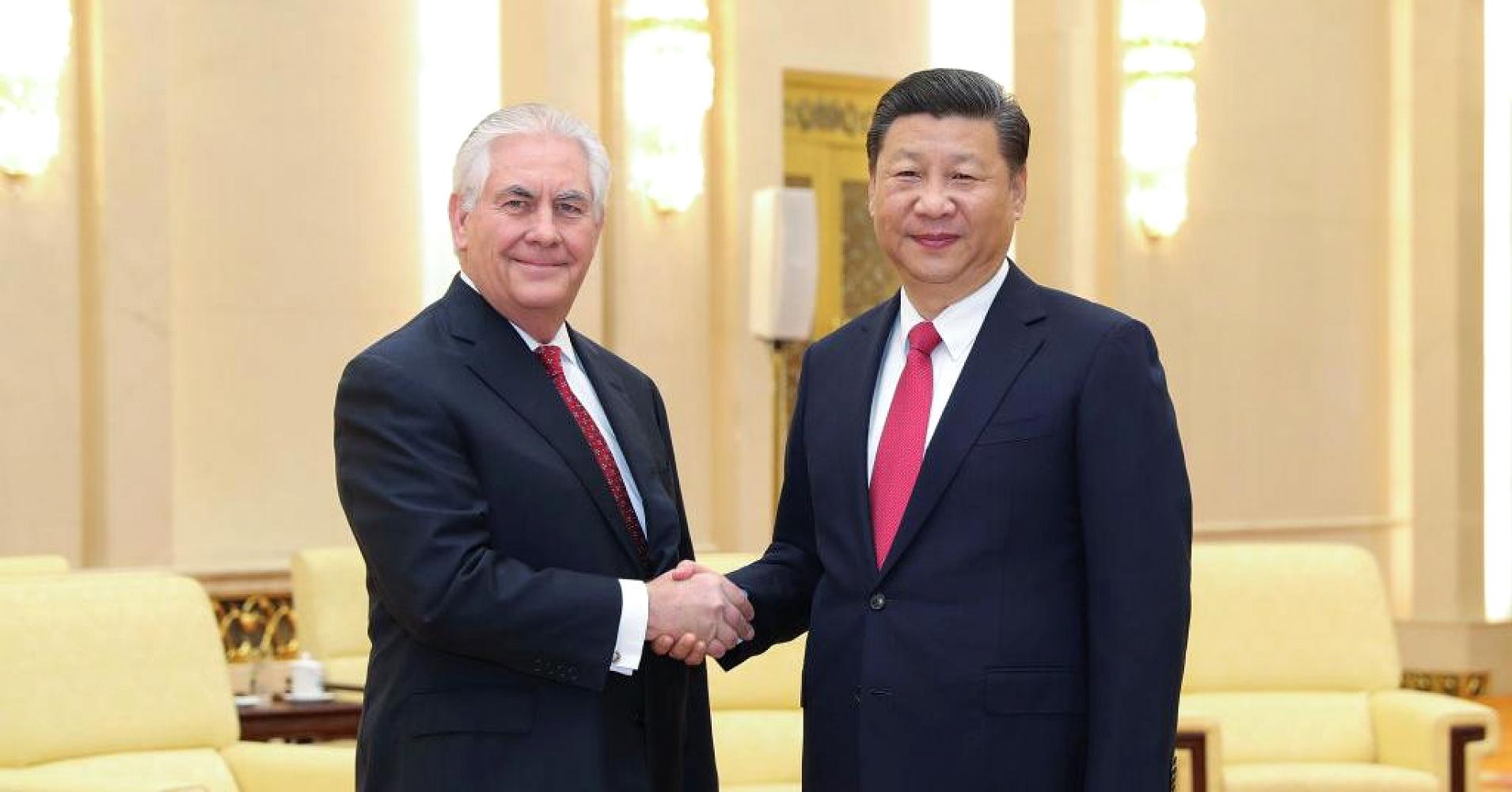
But instead of addressing these issues, Tillerson publicly stuck to a diplomatic approach — in public at least. So Tillerson may have arrived in China talking tough, but his departure was hailed by Chinese cheering.






