

Chronic traumatic encephalopathy, or CTE, is a progressive neurodegenerative disease thought to be caused by repeated injuries to the head, and the new findings suggest it could have been an underlying cause of their dementia.
A full look
The study investigated the lifestyles and career paths of 14 deceased soccer players who had had dementia, 12 of whom died of advanced dementia.
Six of the families granted permission for postmortem examinations to look into the cause of their dementia, and four were confirmed to have CTE. All six also had symptoms of Alzheimer’s disease, a form of dementia.
Postmortem investigations are the only definitive way to identify CTE.
“This is the first time CTE has been confirmed in a group of retired footballers,” said Dr. Helen Ling of the University College London Institute of Neurology, who led the study. “They all sustained minor blows to the head thousands of times.”

McKee noted that because of the players’ ages, it wasn’t uncommon to see both Alzheimer’s and CTE. However, she asked, “can just this exposure to mild impacts not just cause CTE but aggravate Alzheimer’s?”
Ling pointed out that although previous studies have shown a correlation between increased head injuries and greater risk for Alzheimer’s disease, dementia risk also increased with age. At this point, she said, research needed to be done to “find out if dementia is more common in footballers than in the normal population.”
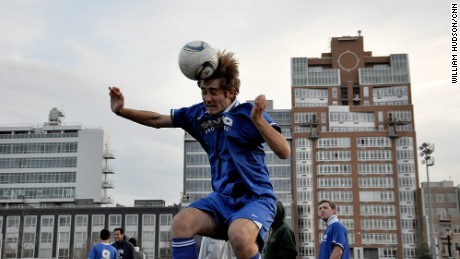
None of the players studied had experienced significant concussions during their careers, indicating that repetitive blows to the head — such as through hitting other players, the ball or goalposts — are playing a key role.
Under the microscope
In the four players diagnosed with CTE, Ling and her team saw the telltale patterns of tau deposits that differentiate that disease from Alzheimer’s.
“All of the players whose brain autopsies showed signs of CTE also had Alzheimer’s pathology, but the relationship between the two diseases remains unclear,” she said. “Both diseases involve a buildup of an insoluble form of tau protein in the brain. However, in CTE, tau tends to accumulate around blood vessels and at the depths of the sulci — the grooves in the brain’s surface — which helps to differentiate CTE from Alzheimer’s pathology under the microscope.”

She and her team believe more research now needs to be conducted to identify the risks posed to professional footballers on the pitch, as the small sample size in this study means the findings cannot be extrapolated on a wider scale.
“I emphasize this is a very small selection of players,” said Huw Morris, a professor of clinical neuroscience at the UCL Institute of Neurology who also worked on the study. “And these are people with a very high amount of playing and exposure.”
What to do?
The team does not advise that members of the public stop playing soccer. Rather, they say, those responsible for the well-being of professionals, such as England’s Football Association, may need to take such factors into account.
“The risk is extremely low of playing recreational football,” Morris said. “This is something the FA are looking at actively.”
Boxing and American football have long been associated with CTE and resulting risks from neurodegenerative conditions, and Morris highlighted how the professions have adapted.
“In the American football league, receivers have the highest rate of CTE acceleration,” Morris said, adding that this was probably due to their increased rate of collisions and impact. “(Both) rugby and (American football) have introduced changes to tackles.”






