

A strong performance by Chile’s left-wing parties in Sunday’s election left conservative presidential front-runner Sebastian Pinera facing a tight battle to win a December runoff and likely opposition to tax breaks in Congress if elected.
Pinera came first with more than 36 per cent of the vote, but his two main leftist rivals made a stronger-than-expected showing, garnering a combined 43 per cent between them.
That unnerved financial markets, which had long seen the billionaire former president as a shoo-in. Chile’s stock index sank five per cent on Monday and the peso currency closed nearly two per cent lower.
Thanks to a surprise surge by a new leftist grouping, Frente Amplio (Broad Front), left-of-centre lawmakers will outnumber Pinera’s Chile Vamos (Let’s Go Chile) voting bloc in both houses of Congress, official results showed on Monday. But no voting bloc will have an absolute majority in either house.
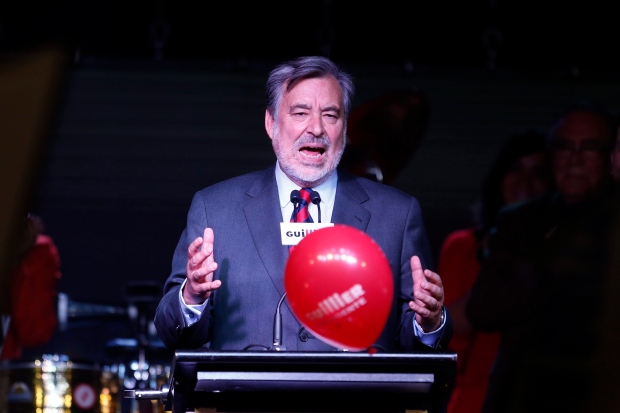
Alejandro Guillier, of the Nueva Mayoria coalition speaks to supporters in Santiago. He finished second in the first round of voting. (Luis Hidalgo/Associated Press)
That would not bode well for Pinera’s plans to cut the corporate tax rate and slash red tape to woo new investments to Chile, the world’s top copper producer.
And a Pinera victory in the Dec. 17 runoff for the presidency was no longer a sure thing, said election forecaster and political scientist Kenneth Bunker.
“It’s all up in the air right now,” Bunker said. “We were just dumbfounded when the results started to come in.”
Pinera, who governed Chile from 2010 to 2014, came in five percentage points short of forecasts by opinion polls before Sunday’s vote.
His runoff opponent, centre-left journalist-turned-senator, Alejandro Guillier, secured two percentage points more than expected. But the main surprise of Sunday’s vote was Frente Amplio candidate Beatriz Sanchez, who garnered twice as many votes as forecast.
“It’s going to be a tight and hard-fought election,” Pinera told foreign media on Monday. “We’re going to appeal to the centre, to the kind of people who want moderation.”
Coalition presents challenges
In another bad sign for Pinera, Chileans went to polls in slightly bigger numbers than expected on Sunday. Analysts consider a low turnout to favour the conservative candidate, as his supporters tend to be more likely to vote. Voter turnout in the first-round was nearly 47 per cent, above pollster CEP’s expectations of 44 per cent.
Chile, a country of 17 million people with a $250 billion US economy, has been one of Latin America’s most business-friendly and stable nations since its transition to democracy in 1990.
Its economy slowed, however, to an average growth rate of 1.8 per cent during outgoing President Michelle Bachelet’s term, with lower copper prices dragging on government revenue.
Guillier has promised to deepen Bachelet’s policies, from expanded access to free university education to protections for striking unions, without departing from Chile’s free-market economic model.
He has a tricky task ahead to attract the support of Chile’s wide-ranging left-of-centre voters.
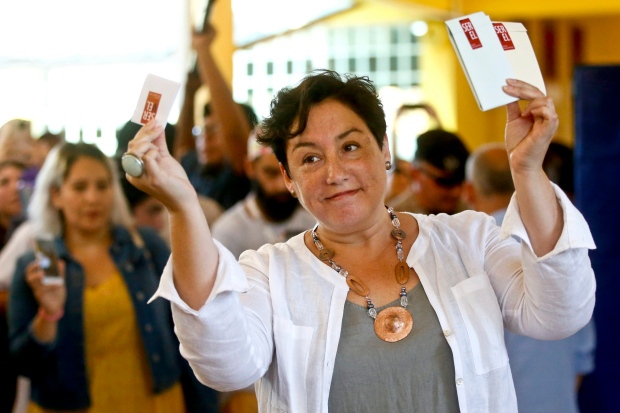
Presidential candidate of the Frente Amplio coalition, Beatriz Sanchez displayed her ballots before casting her vote. It remains to be seen if she will throw her support to Guillier in exchange for influence over policy. (Andres Pina/Aton via AP)
Winning an endorsement from Sanchez — who has proposed new taxes on the mining industry and the “super rich” — could pull him sharply to the left.
Having slammed Pinera as a “step backward” for Chile, Sanchez, a 46-year-old former radio journalist, could rally her supporters to vote for Guillier, but likely in exchange for policy concessions.
“If Mr. Guillier wants us to vote for him, he’s going to have to give in to Beatriz’s proposals,” Sanchez supporter and salesman Hector Mino said. He cited Sanchez’ plan to wipe out student debt and overhaul the public-private pension system to ensure bigger payouts as possible offerings.
But a too-sharp left turn could hurt Guillier’s chances with centrists.
As left-leaning blocs weighed possible alliances, Pinera received a rapid endorsement from far-right Jose Antonio Kast, who was knocked out of the first round race of eight candidates but won nearly eight per cent of votes.
“We’re not going to demand anything in return or condition our support” for Pinera, said Kast, who defended deceased Chilean dictator Augusto Pinochet during the campaign.






